.jpg)
Last Updated: October 2026
A quality of earnings (QoE) report is an independent analysis, typically prepared by a CPA firm, that is the centerpiece of the financial due diligence (FDD) workstream in an M&A transaction. The QoE report is named for its most important section: the quality of earnings (also known as Adjusted EBITDA), where the target company's reported earnings are analyzed for accuracy, sustainability, and whether they are representative of go-forward performance. Other sections typically included are an assessment of net working capital (NWC), identification of debt and debt-like liabilities, and additional analyses that provide key information and feed into the ultimate purchase price for the target.
The QoE report is the document the buyer prices from, the lender underwrites from, and the seller either defends or gets retraded on. It is also only as good as the data underneath it (general ledger being the most important). This guide covers what a quality of earnings report includes, how an EBITDA bridge works, how the report differs from an audit, how it gets built, and what drives cost and timeline.
A quality of earnings analysis is the cornerstone of a financial due diligence project, focusing on a company's historical earnings, usually covering the last two to three fiscal years plus the trailing twelve months (TTM). The analyst starts with net income, adds back interest expense, income taxes, depreciation and amortization, then applies operational adjustments such as one-time legal costs or settlements, stock-based compensation, foreign exchange gains/losses, adjusted owner’s compensation down to normal market rates, and unrealized or non-operating gains.
"Quality" refers to two things.
A company can have accurate books and low-quality earnings, for example, when one customer drives half of revenue, or the owner has been deferring maintenance for three years.
In finance, "QoE" is shorthand for this analysis and the report that documents it. You will also hear "quality of earnings review" or "QoE analysis."
A QoE report is ordered by whichever side of the deal needs to trust, or prove, the earnings of another entity. There are primarily two types:
Most QoE reports cover the sections below:
| Report Section | What It Answers | Typical Inputs |
|---|---|---|
| EBITDA bridge | What is the business's sustainable earnings figure, and how did we get there from the reported number? | Monthly income statement rebuilt from the general ledger, adjustment schedule |
| Normalization adjustments | Which expenses or revenues are one-time, owner-related, out of period, or recorded on the wrong basis? | GL detail, payroll records, invoices, contracts, management interviews |
| Revenue quality and customer concentration | Is revenue recurring, recognized correctly, and spread across enough customers? | Revenue by customer and by month, contracts, AR aging |
| Net working capital and peg | What level of working capital does the business need to operate, and what should the buyer receive at close? | Monthly balance sheets, TTM trends, AR and AP aging |
| Net debt and debt-like items | Which obligations reduce the equity value beyond funded debt? | Balance sheet detail, debt agreements, deferred revenue, accrued liabilities |
| Proof of cash | Do reported revenue and cash activity reconcile to the bank? | Bank statements, cash accounts in the general ledger |
Normalization adjustments restate reported earnings to reflect how the business would perform under normal operations. Most fall into a few categories:
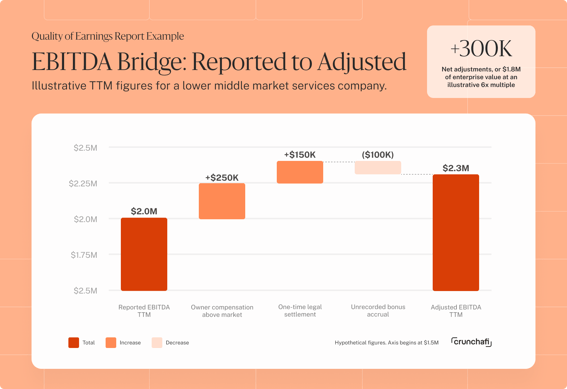
An EBITDA bridge walks from reported EBITDA to adjusted EBITDA one adjustment at a time, with each line supported by a schedule in the data book. Here is a simplified quality of earnings analysis example for a lower middle market services company.
The facts:
| EBITDA Bridge | Amount |
|---|---|
| Reported EBITDA (TTM) | $2,000,000 |
| Add: owner compensation above market ($550,000 less $300,000) | $250,000 |
| Add: one-time legal settlement | $150,000 |
| Less: unrecorded bonus accrual | ($100,000) |
| Adjusted EBITDA | $2,300,000 |
Similar logic applies to the analysis of net working capital. The net working capital analysis looks at historical monthly trends, seasonality, and proposes a normalized target (the "peg") for the purchase agreement's working capital adjustment.
Here’s how the peg works: Say the target's average net working capital over the TTM period is $1.2 million, and the QoE team proposes that figure as the peg. If working capital delivered at close is $1.05 million, the purchase price typically adjusts down by $150,000. If the seller delivers $1.3 million, the price adjusts up by $100,000. The peg protects the buyer from a seller who collects receivables aggressively and stretches payables just before closing.
A QoE report and an audit both examine historical financials, but they answer different questions for different readers.
| Quality of Earnings Report | Financial Statement Audit | |
|---|---|---|
| Purpose | Assess whether earnings are accurate, sustainable, and representative for a buyer or seller | Express an opinion on whether financial statements are fairly presented under GAAP |
| Standard | Typically performed as a consulting engagement under AICPA Statements on Standards for Consulting Services (SSCS) | Generally accepted auditing standards (AICPA) or PCAOB standards for public companies |
| Output | Report of findings, adjusted EBITDA, supporting data book; no opinion | Auditor's opinion on the financial statements |
| Focus | Economic reality: normalized earnings, working capital, debt-like items | Presentation and compliance with the reporting framework |
| Who relies on it | Buyers, sellers, lenders, and investors in a specific deal | Shareholders, lenders, regulators, and the public |
| Timeline | Weeks, driven by deal timing | Months, driven by the fiscal year-end cycle |
| Period covered | Two to three years plus TTM, analyzed monthly | One fiscal year, with prior-year comparatives |
A QoE report is built from the general ledger up. The workflow below is the typical sequence:
A quality of earnings report typically takes three to six weeks and costs anywhere from the low five figures to six figures, depending on the target's size, complexity, and data quality. There is no single number.
Much of the time spent on FDD projects is waiting for files to arrive, reviewing the data sent for completeness and accuracy, then reformatting the data to be useful. On a six-week deal, that delay comes straight out of the time your team needed for adjustment work.
This is the gap automation targets. As covered in our look at AI in financial due diligence, anomaly detection and standardized output only work once the underlying data is complete and structured. The same is true for a human analyst reading GL detail for a missing accrual.
Crunchafi Data Extraction replaces the export-and-reformat loop. The target company grants a one-time, read-only secure connection to its accounting system, including QuickBooks Online, Sage Intacct, NetSuite, and Xero. Crunchafi pulls the full general ledger in minutes and returns standardized Excel output built to drop into your data book.
What that changes for a QoE engagement:
What it does not do matters just as much. Data Extraction does not identify adjustments, set the peg, or write the report. Judgment stays with your team. For a closer look at how extraction tools compare, see our guide to financial data extraction software and our roundup of automated financial due diligence tools.
See how Crunchafi Data Extraction works, or schedule a demo to walk through it on your next deal.
A quality of earnings (QoE) report is an independent analysis, typically prepared by a CPA firm, that is the centerpiece of the financial due diligence (FDD) workstream in an M&A transaction. The QoE report is named for its most important section: the quality of earnings (also known as Adjusted EBITDA) that assesses whether a target company's reported earnings are analyzed for accuracy, sustainability, and whether they are representative of go-forward performance.
An audit provides reasonable assurance that financial statements are fairly presented under GAAP and ends in an auditor's opinion. A quality of earnings report provides no assurance or opinion. It analyzes the economic reality of earnings for a specific transaction, including normalized EBITDA, working capital, and debt-like items.
A quality of earnings report is typically prepared by the financial due diligence or transaction advisory team at a CPA firm, or by a specialized advisory firm. The preparer is independent of the target company.
A quality of earnings analysis typically includes an EBITDA bridge from reported to adjusted earnings, normalization adjustments, revenue quality, customer concentration analysis, and a proof of cash reconciling reported activity to bank records.
A quality of earnings report typically takes three to six weeks, based on published estimates from CPA and advisory firms. Timing depends on company size, entity count, data quality, and scope. Many firms start the timeline only once complete financial data is received, so data delivery often decides the schedule.
Quality of earnings report costs vary with deal size, complexity, and scope. Published fee ranges from CPA and advisory firms put smaller lower middle market engagements roughly between $10,000 and $50,000, while larger or multi-entity targets can run into six figures.
Adjusted EBITDA in a quality of earnings report is reported EBITDA restated for nonrecurring items, above or below-market owner compensation, related-party transactions, and accounting corrections. It represents the sustainable earnings a buyer can expect to continue under new ownership and is usually the figure a purchase price multiple is applied to.
A quality of earnings report is not legally required to sell a business, but most institutional buyers and many lenders expect one. Sellers often commission a sell-side quality of earnings report before going to market to surface issues early, support their asking price, and reduce the risk of a price renegotiation during diligence.
A buy-side quality of earnings report is commissioned by the acquirer after a letter of intent to validate the earnings it bid on. A sell-side quality of earnings report is commissioned by the seller before marketing the business to identify and address issues early.
A quality of earnings analysis requires general ledger detail and monthly trial balances for the review period, typically two to three years plus the trailing twelve months. Teams also request financial statements, tax returns, bank statements, AR and AP aging, payroll records, and key customer, vendor, and debt agreements.
Financial data extraction software speeds up a quality of earnings report by pulling the target's general ledger directly from its accounting system instead of waiting on manual exports. Crunchafi Data Extraction uses a one-time, read-only secure connection to return the full general ledger in standardized Excel output, so analysis can start sooner.