FRS 102 is The Financial Reporting Standard applicable in the UK and Ireland. This standard applies to financial statements of entities not applying IFRS, FRS 101, or FRS 105. FRS 102 is effective 1 January 2026 and is designed to apply to the general purpose financial statements and financial reporting entities, including those that are not considered companies and those that are not profit-oriented. FRS 102, Section 20, requires all leases to move onto the balance sheet for the first time. The result: more calculations, more disclosures, more audit scrutiny, and considerably more pressure on already stretched accounting teams.
If your firm or your clients hold leases, those obligations now appear on the balance sheet. Spreadsheets that worked before will not scale to what's required. Firms that start preparing now will close faster, carry lower audit risk, and avoid the compliance crunch that's coming in the back half of 2026.
FRS 102 is the Financial Reporting Standard applicable in the UK and Ireland, issued by the Financial Reporting Council (FRC). It applies to most entities that are not using full IFRS, FRS 101, or FRS 105. This means the overwhelming majority of UK/IE companies. Publicly traded companies do not apply in most cases because they are required to adhere to the IFRS standards.
With the types of changes and the types of businesses that typically follow FRS 102, most entities are affected in practice because even a single office lease is typically material enough to require application of the standard and associated disclosures in the financial statements.
The 2026 update brings lease accounting and revenue recognition meaningfully closer to international standards without requiring full IFRS adoption.
One critical distinction for UK/IE accounting teams: because statutory accounts are filed publicly, every entity subject to FRS 102 is on record. Regulators, auditors, and lenders can access those filings. Errors or non-compliance carry real reputational and regulatory consequences.
The September 2024 update to FRS 102 introduces two material changes for most accounting teams: a new lease accounting model under Section 20, and a revised five-step revenue recognition model under Section 23.
Both changes take effect for periods beginning on or after 1 January 2026. For entities with a 31 December year-end, that means full compliance is required now. For entities with a 31 March year-end, the effective date is 1 April 2026.
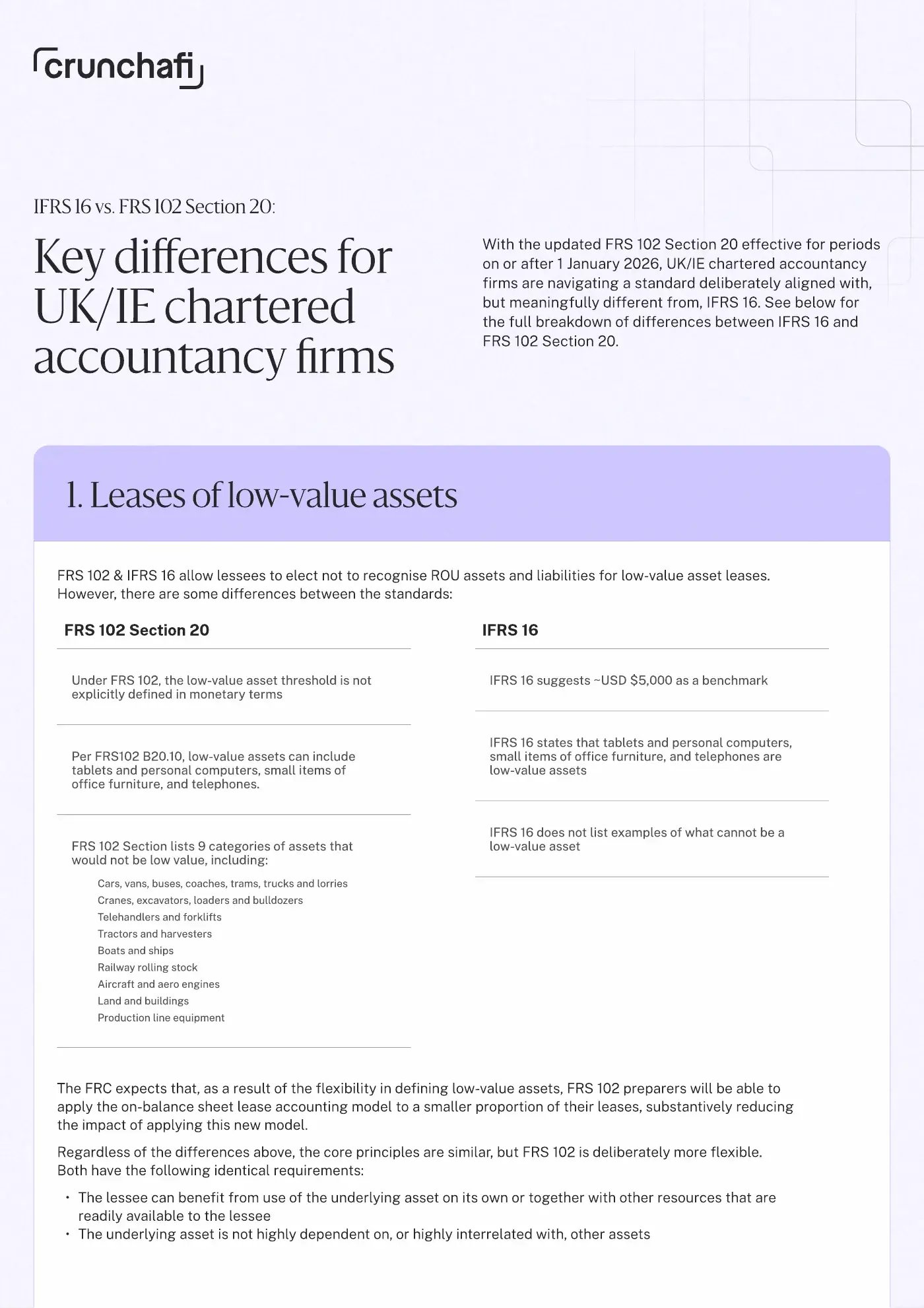
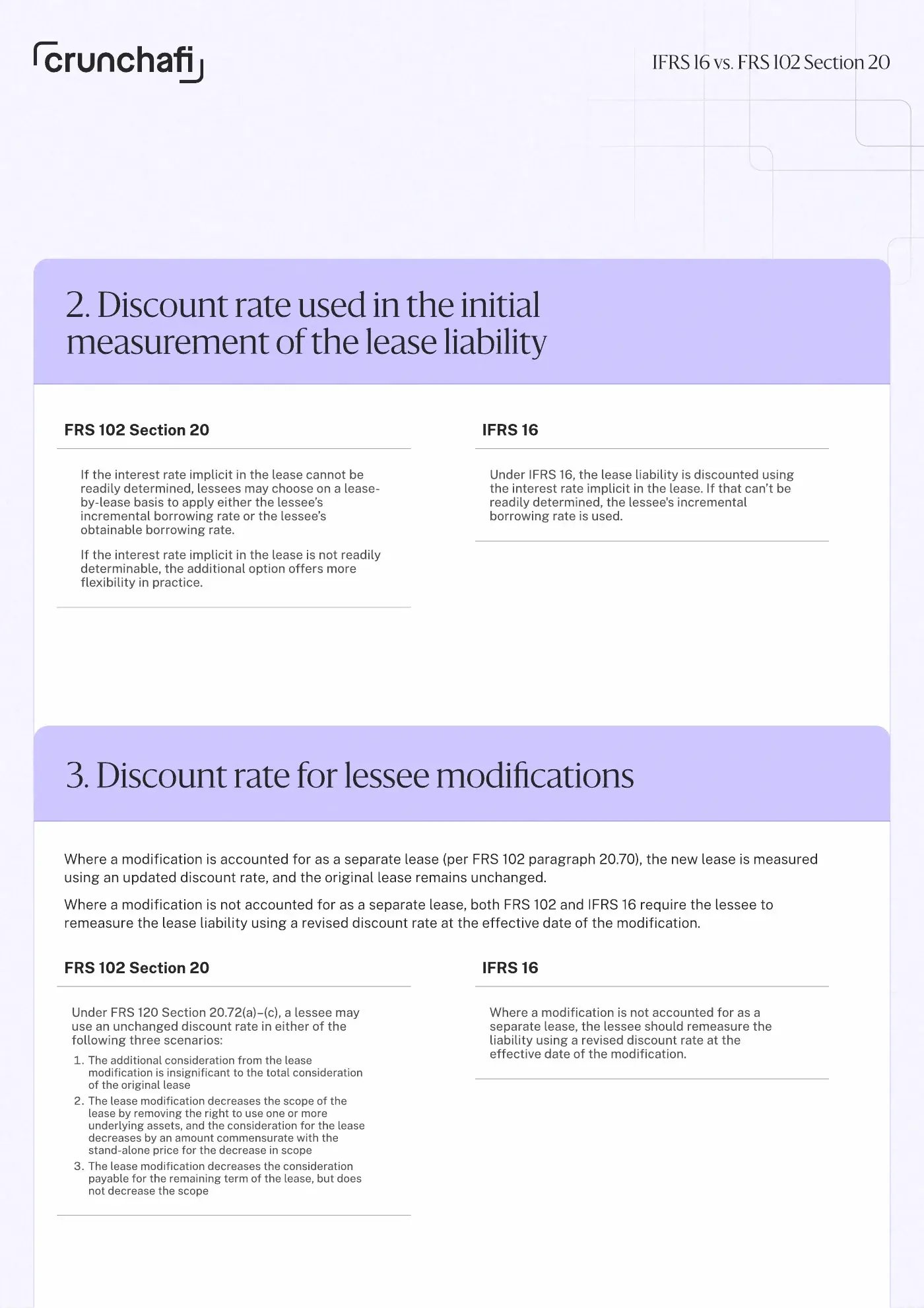
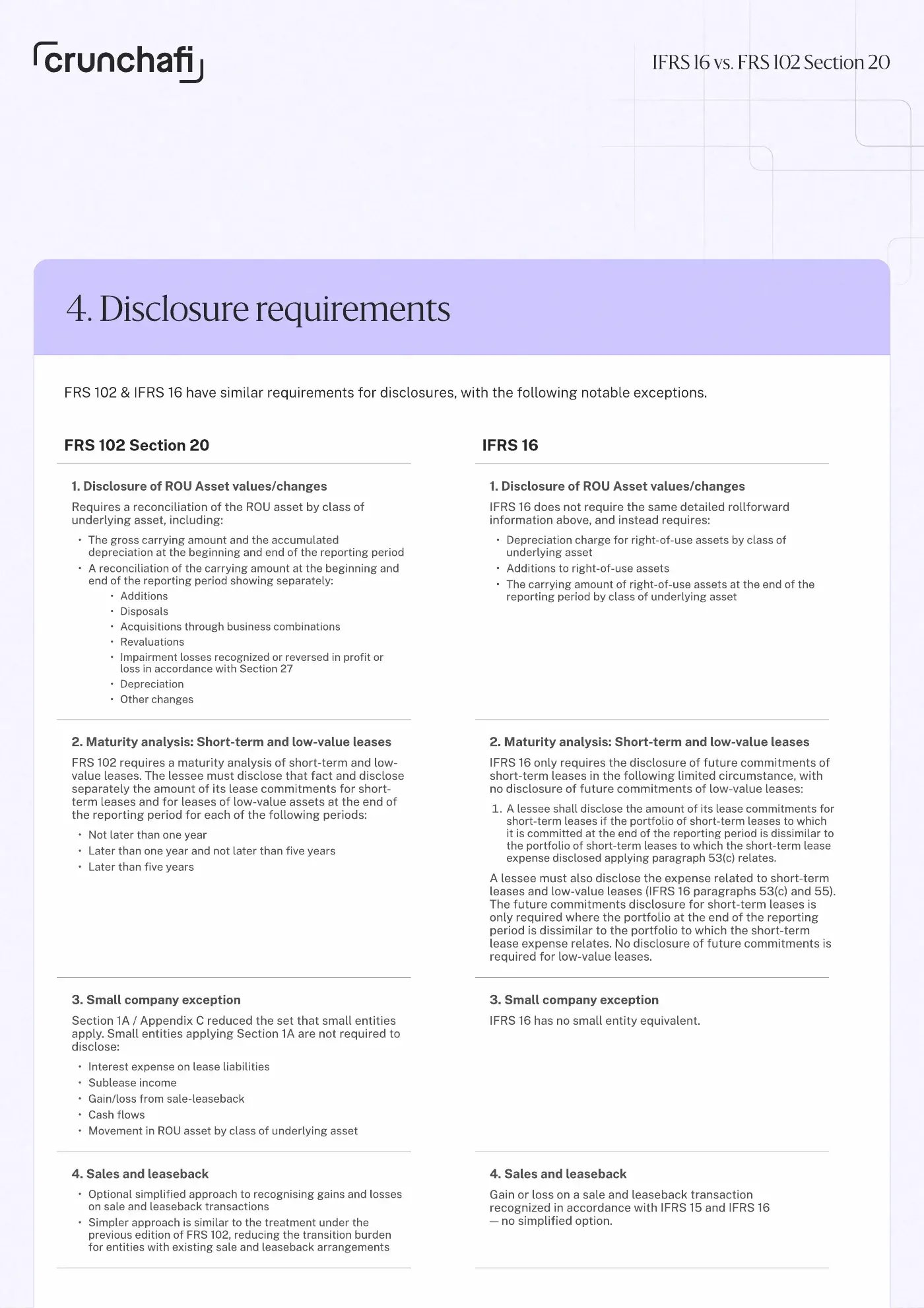
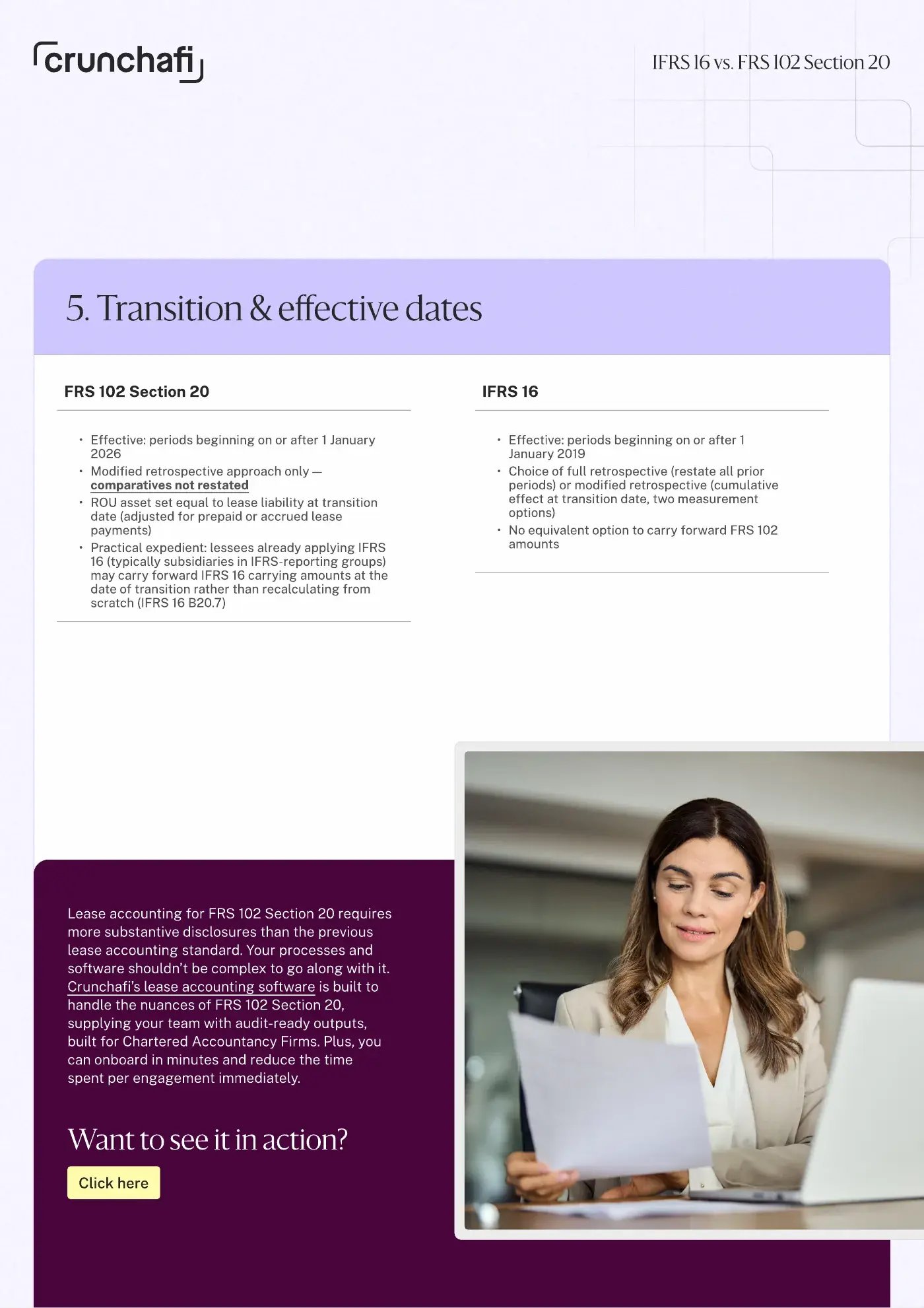
The alignment with IFRS 16 is deliberate but not complete. The guide below breaks down where Section 20 diverges across low-value exemptions, discount rates, modifications, disclosures, and transition.
In March 2025, the FRC issued amendments to FRS 102 and FRS 105 (UK company size thresholds and IE company size thresholds) to reflect changes in UK/IE company law introduced by The Companies (Accounts and Reports) (Amendment and Transitional Provision) Regulations 2024.
The amendments update the monetary thresholds used to determine whether a company qualifies as a small entity or a micro-entity. Under the revised thresholds, a small company must not exceed two of the following: turnover of £/€15 million (previously £10.2 million or €12 million), a balance sheet total of £/€7.5 million (previously £5.1 million or €6 million), and 50 employees. For micro-entities, the updated thresholds are turnover of £1 million (previously £632,000) or €900,000 (previously €700,000) and a balance sheet total of £500,000 (previously £316,000) or €450,000 (previously €350,000), with the employee limit remaining at 10.
These changes are purely a consequence of the legislative update and do not alter the underlying financial reporting requirements within FRS 102 or FRS 105. The practical effect is that some entities which previously fell outside the small or micro-entity regimes may now qualify, potentially reducing their reporting obligations. The amendments apply for financial years beginning on or after 1 January 2026.
Lease accounting under the updated Section 20 is the most operationally complex change for the majority of firms and their clients. It is also where the risk of error is highest.
What's now in scope:
This list is illustrative rather than exhaustive, and other arrangements may also fall within the updated lease definition depending on contractual terms.
That last category, embedded leases, is of great importance. A contract for dedicated server infrastructure or a fleet management arrangement may contain a lease under the updated definition, even if it was never treated as one before.
Available exemptions:
Both exemptions must be assessed, documented, and disclosed where applicable, even when applied correctly under the standard. Applying them without a clear audit trail creates exactly the kind of exposure that auditors will scrutinise during the first post-transition cycle.
Why spreadsheets break here:
The core calculations of discount rate application, right-of-use asset amortisation, and lease liability unwinding are manageable in isolation. The problem is scale and complexity at the disclosure stage. The Section 20 disclosure requirements are substantially more detailed than what was required under the prior lease standard. Tracking modifications, reassessments, variable payments, and exemption elections across a portfolio of leases in a spreadsheet fails due to formula errors, version control issues, and the lack of a repeatable audit trail.
For chartered accounting firms managing multiple clients, the problem scales. Each client portfolio requires the same rigour, the same documentation, and the same disclosure output, but firms are running those processes simultaneously across dozens of engagements during busy season.
The 2026 changes arrive at a crucial time. Here's what accounting for FRS 102 looks like in practice:
Chartered accounting firms bear this implementation burden directly. The tool decisions made now will determine how efficiently they can serve clients through the first full compliance cycle and beyond.
Audit readiness requires more than accurate calculations. It requires journal entries that tie directly to balance sheet movements, disclosure outputs that meet the letter of Section 20, and a clear record of the judgments applied at each stage. Manual processes cannot reliably produce that at scale.
Preparation should be underway now. For entities with 31 December year ends, the first reporting period under the updated standard has already begun.
Practical steps:
For chartered accounting firms, the additional step is standardisation: a consistent process and consistent outputs across clients, so that busy season volume does not translate directly into busy season error.
Crunchafi's lease accounting software is purpose-built to automate the calculations, journal entries, and disclosures required under FRS 102 Section 20. As the #1 lease accounting software for chartered accounting firms, your team will spend less time on calculations, leading to massive economies of scale. Request a demo to see how Crunchafi supports FRS 102 for lease accounting (Section 20) compliance.
FRS 102 is the Financial Reporting Standard applicable in the UK and Ireland, covering most entities that do not apply IFRS. It governs how statutory accounts are prepared and filed with Companies House.
No. FRS 102 is a simplified framework designed for non-publicly accountable entities. The September 2024 update aligns certain areas, particularly lease accounting and revenue recognition, more closely with IFRS 16 and IFRS 15, but FRS 102 remains a distinct standard with its own requirements and thresholds.
Any entity preparing statutory accounts under FRS 102 for periods beginning on or after 1 January 2026. This includes large and small entities across the UK and Ireland. Micro entities filing under FRS 105 are largely unaffected, though some elect to file under FRS 102 Section 1A regardless.
Under the updated Section 20, the lessee distinction between operating and finance leases is removed. As a result, more leases must now be recognised as right-of-use assets and corresponding lease liabilities, subject to the short-term and low-value recognition exemptions.
Entities must calculate the present value of future lease payments using a discount rate, and produce expanded disclosures, all with an audit-ready record of the judgments made.