
Last updated: September 2026
M&A financial due diligence (FDD) is the process of analyzing a target company's financial records to confirm accuracy, identify risks, and help buyers determine enterprise value. For CPA firms, it's also a race against the clock. The firms that close deals faster, with cleaner data, win more of them.
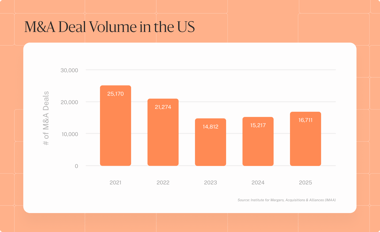
Source: Institute for Mergers, Acquisitions & Alliances (IMAA)
While the graph from IMAA shows that M&A deals in the US have declined over recent years, the outlook is positive.
According to EY-Parthenon's 2026 Deal Barometer, corporate M&A deal volume in the US is projected to grow 11% in 2026. In short, there's work out there if a firm can find the bandwidth to take it on. For most firms, that means bringing on more staff. Unfortunately, hiring has been more difficult than ever.
How, then, can M&A financial due diligence firms rise to this challenge? How can they decrease deal time and improve results? How can an already maxed workforce increase throughput and manage more deals as the market continues to expand?
Technology is starting to rise to the complexity of today's deals. With smart tools that can assist with the manual, time-consuming tasks, firms can improve their efficiency for M&A due diligence, increasing both the number of deals they can work on and the margins on those deals. And what firm doesn't want a better bottom line?
Let's look at the M&A process, where the biggest opportunities exist for technological assistance, and what those tools for financial due diligence are.
For a company looking to sell, the M&A process starts with planning and marketing. The company prepares financial documents and other materials to present to a list of prospective buyers.
If a prospective buyer is interested and both sides agree to explore a transaction, due diligence begins. Financial due diligence firms get involved to analyze the target's financial situation, confirming financial details, identifying risks, and helping the buyer determine enterprise value.
M&A financial due diligence involves working with the seller to obtain financial reports and documents, preparing a databook where analysts can identify issues and perform analysis, and presenting findings to the buyer.
The two parties then negotiate, with the FDD report shaping deal terms. When both sides agree, the purchase agreement is signed and the transaction closes.
In practice, this process is a complicated, high-pressure back-and-forth with tight timelines, incomplete data, and a lot riding on the accuracy of the analysis.
Here’s a quick, high-level view of the M&A process:
The M&A process is full of potential friction points, but a few consistently slow deals down and compress firm margins:
In all of these areas, analysts can spend days, if not weeks, worth of effort, drastically slowing the pace of the deal. Firms should focus on ways technology can help improve in these areas.
FDD is a data-intensive discipline, and the right tech stack makes a measurable difference in deal speed, output quality, and firm margins. Most FDD teams rely on a combination of three software categories:
Of the three categories, data extraction has the highest direct impact on deal velocity. It eliminates the manual request-and-reformat cycle that consumes the early weeks of most engagements.
Financial data extraction software does one thing exceptionally well: it gets clean, structured data out of a target's accounting system and into the hands of analysts quickly.
Here's how it works in a typical FDD engagement:
This gives FDD teams:
The right technology changes the economics of the entire engagement by:
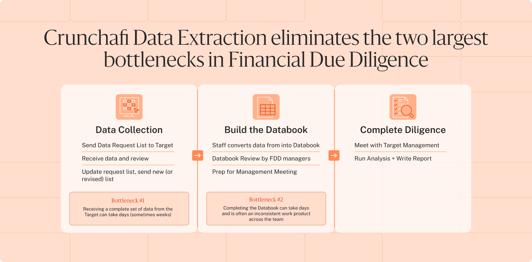
Crunchafi Data Extraction is purpose-built for FDD engagements. It connects directly to the target's accounting system, pulls and normalizes the full general ledger and transaction history, and delivers a structured Excel workbook that analysts can use immediately.
No manual data entry. No reformatting. No chasing the target for reports they're not sure how to run.
The databook components are automatically produced with each pull. That consistency reduces review time, minimizes errors, and makes it easier to scale deal volume without adding headcount.
For FDD teams evaluating data extraction tools, Crunchafi's financial due diligence solution is built specifically for this workflow, not adapted from a general-purpose data tool.
If you want to reduce burnout for your team, grow your deal capacity without adding headcount, improve consistency in your output across the team, and reduce time spent on each deal, leading to better margins, Crunchafi’s Data Extraction software is the answer. Our customers report reduced deal time and hours saved on mundane, manual data manipulation tasks.
Interested in incorporating leading technology into your process? Reach out to book a demo today!
M&A financial due diligence is the process of analyzing a target company's financial records to verify accuracy, identify risks, and help the buyer determine enterprise value. It typically involves data gathering from the target, preparation of an Excel databook, and a findings report presented to the buyer.
An FDD team analyzes the target's financial statements, transaction history, and accounting records. They identify quality of earnings adjustments, working capital trends, and financial risks that inform deal terms and valuation.
Data gathering from the target is consistently the first and most significant bottleneck. Analysts often spend days or weeks collecting financial reports in the right format before any analysis can begin. Financial data extraction software eliminates most of this friction by connecting directly to the target's accounting system.
Financial data extraction software connects to a target company's accounting system or ERP, pulls the general ledger and transaction history, and normalizes the data into a structured format analysts can immediately work with.
By automating the data gathering and normalization process, data extraction software compresses the early stages of an FDD engagement from days or weeks to minutes. Analysts receive a clean, structured workbook immediately and can move directly into analysis without reformatting raw data.
Yes. Manual data gathering and reformatting are primary contributors to analyst burnout in FDD practices. Automating these tasks frees analysts to focus on higher-value analysis work.