.jpg)
PLEASE NOTE: All currency specifications within these journal examples will use the generic “CU” currency designation for the purposes of illustration herein.
The revised FRS 102 Section 20 puts most leases on the balance sheet. For many clients, that means new entries, new schedules, and new disclosure obligations began on 1 January 2026.
How to account for a lease under the revised standard depends on what type of lease it is. Work through each lease example below in turn, then pay close attention to the remeasurement section, which is where spreadsheet-based processes tend to fall apart first.
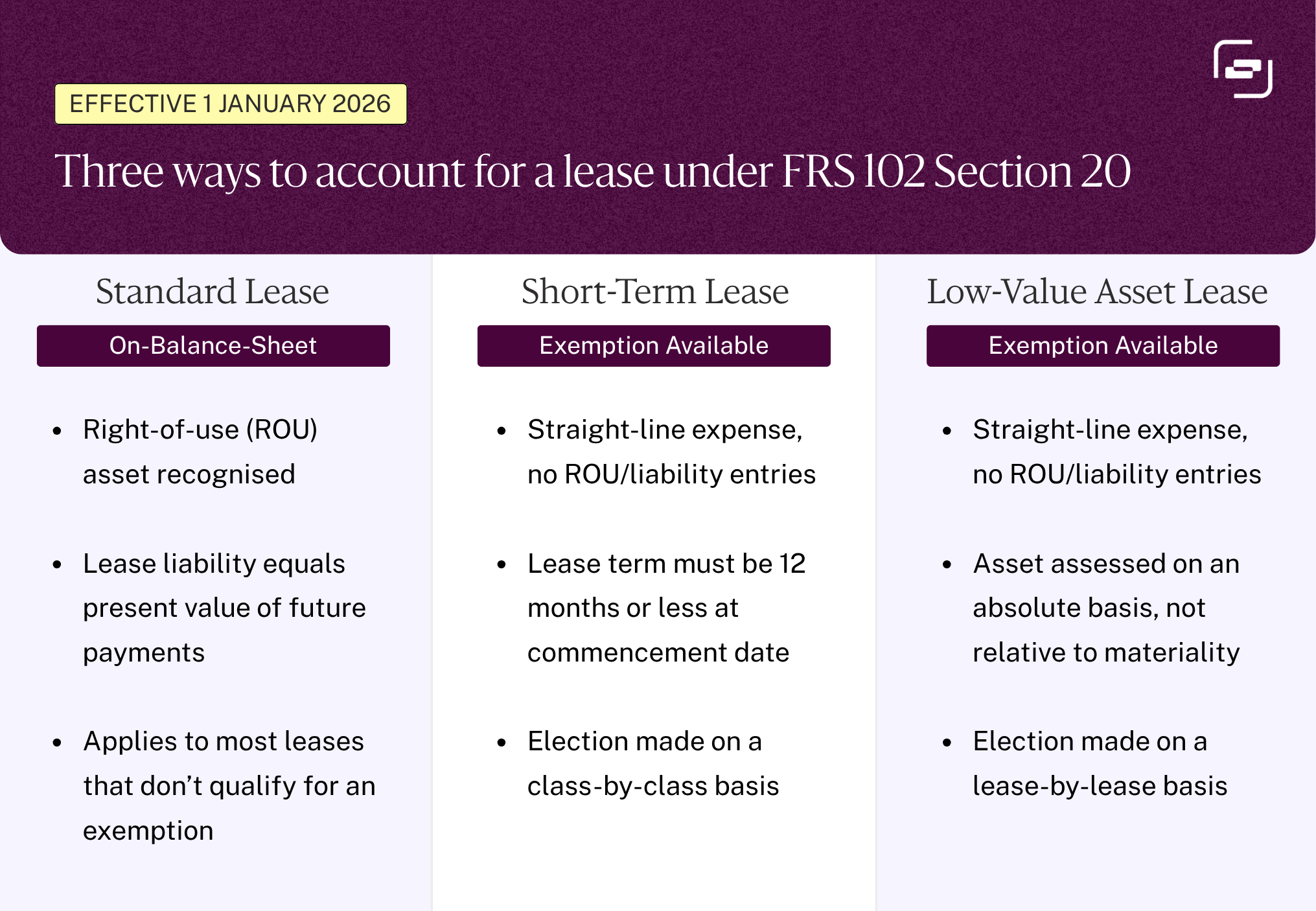
The default under revised Section 20 is on-balance-sheet recognition. If a lease does not qualify for the short-term or low-value asset exemption, or if the lessee simply chooses not to take an exemption that is available, a right-of-use (ROU) asset and a corresponding lease liability are recorded on the balance sheet at the commencement date. This is regardless of how the lease would previously have been classified.
The FRS 102 Section 20 journal entries below walk through each stage of on-balance-sheet lease accounting using a five-year equipment lease as the example.
.png?width=2031&height=1406&name=FRS102_Blog_Graphics%20(1).png)
Step 1: Initial Recognition
On day one, two things go on the balance sheet: a right-of-use asset and a lease liability. The liability is calculated as the present value of the future lease payments, discounted at the interest rate implicit in the lease. If that rate is not readily determinable, which is often the case, the lessee can use the incremental borrowing rate or the obtainable borrowing rate instead. That choice is made on a lease-by-lease basis.
The ROU asset is built from the lease liability, adjusted by adding any initial direct costs, prepaid lease payments, and estimated dismantling costs, then reduced by any lease incentives received. In this example, the present value of lease payments is CU 49,586. An ROU Asset and Lease Liability is added to the statement of financial position in this amount. The ROU asset is categorized as a non-current asset, while the lease liability is split between the current and non-current portion.
-1.png?width=2031&height=1408&name=FRS102_Blog_Graphics%20(2)-1.png)
Step 2: Depreciation of the Right-of-Use Asset
In most cases where ownership does not transfer and the lessee is not reasonably certain to exercise a purchase option, the asset is depreciated over the shorter of the lease term and the useful life of the right-of-use asset. Where ownership does transfer or where exercise of a purchase option is reasonably certain, use the useful life of the underlying asset instead.
In this example, ownership does not transfer so the ROU Asset will be depreciated over the lease term.
Using straight-line depreciation over five years:
Annual depreciation = CU 49,586 ÷ 5 = CU 9,917
This amount is booked to accumulated depreciation on the statement of financial position, and depreciation expense on the statement of comprehensive income.
-1.png?width=2031&height=1408&name=FRS102_Blog_Graphics%20(1)-1.png)
Step 3: Interest on the Lease Liability
Section 20 requires interest to be calculated using the effective interest method. That means the interest expense shifts each year as the liability reduces. It’s not a flat figure. What stays constant is the periodic rate applied to the remaining balance.
The discount rate used at commencement is the rate implicit in the lease. In practice, the rate implicit in the lease is often hard to pin down. Where it cannot be readily established, on a lease-by-lease basis the lessee uses the incremental borrowing rate (what it would pay to borrow a similar amount over a similar term with similar security) or the obtainable borrowing rate (what it would pay to borrow the total undiscounted lease payments over a similar term). The interest is recorded on a periodic basis.
Interest: CU 49,586 × 3.5% / 12 = CU 145 for the first month.
Interest changes monthly as we’re adding each month of interest to the lease liability. Payments first get applied to interest and then to the remaining principal.
For this example, total interest for the year is CU 1,764.
This interest expense sits below operating profit on the income statement.
-1.png?width=2031&height=1408&name=FRS102_Blog_Graphics%20(3)-1.png)
Step 4: Lease Payment
When the CU 11,000 annual payment is paid, the lease liability is reduced by the full amount of the payment. The interest for the first year of the lease (CU 1,764) was already added to the liability in Step 3, so the net reduction in the carrying amount (the principal element) is CU 9,236.
Year 1 principal reduction: CU 11,000 − CU 1,764 = CU 9,236. -1.png?width=2031&height=1408&name=FRS102_Blog_Graphics%20(4)-1.png)
Amortisation Schedule (Years 1–3)
The table below shows how the liability changes over the first three years. Notice how the interest expense reduces each year as the balance reduces. This is the effective interest method working exactly as intended. We will revisit the Year 3 closing lease liability balance of CU 20,880 in the remeasurement example later on. .png?width=2031&height=1406&name=FRS102_Blog_Graphics%20(6).png)
A short-term lease is one with a lease term of 12 months or less at the commencement date, with no purchase option. When assessing the lease term, consider whether the lessee is reasonably certain to exercise any extension option. If they are, that period counts towards the term.
When the short-term exemption is elected, no ROU asset or lease liability is recognised. The lease payments go through the income statement on a straight-line basis over the lease term, or on another systematic basis that better reflects how the lessee benefits from the asset.
The exemption is voluntary. It must be applied consistently across all leases within the same asset class. If a short-term lease is modified, or if the assessed lease term changes, the lease is treated as a new lease from that point forward.
One other thing worth noting is that the short-term exemption only removes the requirement to recognise the lease on the balance sheet. The disclosure obligations under Section 20 still apply.
-1.png?width=2031&height=1408&name=FRS102_Blog_Graphics%20(5)-1.png)
Step 1: Recognising the Monthly Lease Expense
The lessee takes the short-term exemption and recognises the payments as a straight-line expense. With CU 12,000 spread evenly over 12 months, the monthly short-term lease expense is CU 1,000.
-1.png?width=2031&height=1408&name=FRS102_Blog_Graphics%20(6)-1.png)
Step 2: Prepayments and Accruals
Where payments do not line up with the straight-line charge, a prepayment or accrual is needed to bridge the gap. A lease paid quarterly in advance, for example, requires a prepayment adjustment each month to spread the cost evenly. This is simple enough for one lease, but easy to lose track of across a large portfolio.
Handling a Rent-Free Period Under the Short-Term Exemption
A rent-free period does not change the straight-line approach. The total cost is still spread evenly across the full term.
Example: A 12-month lease at CU 1,000 per month that includes a three-month rent-free period. Total cash payments = CU 9,000 (nine months at CU 1,000). That CU 9,000 is recognised evenly over all 12 months at CU 750 per month.
During the rent-free months, the journal entry credits an accrued liability rather than cash. Once payments begin, that liability unwinds alongside the cash going out. Rent-free periods, stepped rents, and irregular payment patterns all need careful tracking to keep the straight-lining consistent.
.png?width=2031&height=1406&name=FRS102_Blog_Graphics%20(9).png)
The low-value asset exemption works differently than the short-term exemption. It applies if the lessee can benefit from the use of the asset on its own or together with other resources readily available to the lessee and the underlying asset is not highly dependent on or highly interrelated with other assets. The low value exemption can be applied on a lease-by-lease basis rather than by asset class.
The value of the asset is assessed in absolute terms independently of the lessee's size or the value of the lease payments. Section 20 does not set a specific monetary threshold. Instead, it sets out categories of asset that would not qualify as low value such as land and buildings, motor vehicles, aircraft, railway rolling stock, production line equipment, and assets of a similar value. The Basis for Conclusions to FRS 102 (referencing IFRS 16) notes that tablet computers, small items of office furniture, and telephones would be acceptable candidates for the exemption, though neither list is exhaustive.
The exemption cannot be used where the lessee subleases the asset or expects to. And, as with the short-term exemption, the balance sheet treatment changes but the disclosure requirements remain.
-1.png?width=2031&height=1408&name=FRS102_Blog_Graphics%20(7)-1.png)
Recognising the Monthly Lease Expense
The lessee takes the low-value exemption. Monthly payments of CU 50 are recognised as a straight-line expense, with nothing recorded on the balance sheet.
-1.png?width=2031&height=1408&name=FRS102_Blog_Graphics%20(8)-1.png)
The accounting here is genuinely straightforward. In terms of documentation however, the decision to apply the low-value exemption to a lease needs to be recorded and defensible if it is challenged at audit. An undocumented exemption election is not a safe one.
Remeasurement applies to on balance sheet leases. It is where the accounting gets more involved, and where things tend to go wrong when teams are managing multiple client portfolios manually.
A lease liability needs to be remeasured when any of the following happen:
When remeasurement is triggered, recalculate the lease liability at the revised present value of the future payments. The discount rate used depends on what triggered it:
The ROU asset is adjusted by the same amount as the lease liability in many cases. The only exception is where the ROU asset carrying amount has already reached zero. In that case, any remaining reduction flows through a gain/loss account on the income statement instead.
Lease modifications that reduce the scope of the lease are handled slightly differently. The ROU asset carrying amount is reduced proportionately to reflect the partial or full termination, and any gain or loss on that reduction is recognised in the income statement.
Returning to our five-year equipment lease example, at the start of Year 4, the client extends the lease by two additional years, for a total of four remaining years, with revised annual payments of CU 10,000 made in arrears for the remaining four years. Since the lease term has changed, a revised discount rate applies, 4% in this example.
The revised lease liability is the present value of the remaining payments under the new terms which is CU 36,236 for this illustration
.png?width=2031&height=1406&name=FRS102_Blog_Graphics%20(12).png)
After remeasurement, depreciation is updated to adjust for the remaining lease term, and a new amortisation schedule starts from the date of remeasurement.
A single lease remeasurement is manageable manually, but when there are dozens across multiple clients and remeasurement events can land at any point in the year, the manual rebuild becomes a real time cost and a real risk. One broken formula can corrupt an entire schedule.
.png?width=2031&height=1406&name=FRS102_Blog_Graphics%20(13).png)
For leases that weren’t on the Balance Sheet before, FRS 102 section 20 has a notable impact:
For clients whose leases weren’t required on the balance sheet, this is a meaningful change. It is worth identifying which client leases are affected early. If any clients have loan covenants tied to gearing or net asset ratios, that conversation needs to happen before the accounts are drafted.
For leases under the short-term or low-value asset exemptions, there is limited balance sheet impact. However, these leases still require consistent straight-lining, accurate tracking, and proper disclosure in the statutory accounts.
Recalculate the lease liability at the revised present value of the future payments. The difference between the old and new carrying amount is recognised as an adjustment to the ROU asset. The discount rate used depends on the trigger: a change in lease term or purchase option assessment needs a revised rate; a change in an index, rate, or residual value guarantee amounts uses the original rate (unless the change stems from floating interest rates).
Short-term leases (a lease term of 12 months or less at commencement, no purchase option) and leases of low-value assets. Both exemptions are voluntary. The short-term exemption must be applied consistently across all leases within the same asset class. The low-value exemption can be taken lease by lease. A lease cannot qualify as low value if the lessee subleases or expects to sublease the asset.
Most leases now add both an ROU asset and a lease liability, increasing both sides of the balance sheet. This flows directly into gearing ratios, net asset values, and potentially loan covenant calculations. Leases qualifying for the short-term or low-value asset exemption are the exception, as no ROU asset or lease liability is recorded on the balance sheet.
The short-term exemption is about lease length: 12 months or less at commencement, no purchase option, and applied consistently across all leases within the same asset class. The low-value exemption is about asset value: assessed in absolute terms, independent of the lessee’s size, applied lease by lease. Both result in straight-line expense recognition with nothing on the balance sheet. Both also still require disclosure in the statutory accounts.
For a single lease, working through these entries manually is entirely achievable. The challenge for chartered accountancy firms is doing this reliably for every lease, across every client, period after period, while handling remeasurement events whenever they land mid-cycle.
Keeping amortisation schedules up to date, tracking remeasurement triggers, documenting exemption elections, producing audit-ready workings, and getting all of it into correctly populated disclosure notes adds up to a lot of effort as well as an increased chance for errors to occur. That is the point at which purpose-built lease accounting software earns its place.
If you are working out how to manage this across your client base, our complete guide to FRS 102 Section 20 lease accounting is a good place to start.