
The revised FRS 102 Section 20 draws heavily on IFRS 16 in its mechanics, but the two standards were built for different reporting populations with different goals.
IFRS 16 was developed to provide a single lessee accounting framework for entities reporting under IFRS. FRS 102 Section 20 applies to the much broader population of entities reporting under UK and Ireland GAAP. This includes any entity not required or choosing to apply IFRS, FRS 101, or FRS 105. The revised FRS 102 Section 20 (effective 1 January 2026) removes the finance/operating lease distinction for lessees, introducing an on-balance-sheet model based on the same principles as IFRS 16. The two-classification distinction is retained for lessors only.
The result is two standards that look similar in places and diverge in others. With the revised FRS 102 Section 20 now in effect, here is a practical breakdown of where the two standards align and where they part ways.
Seven Areas Where FRS 102 and IFRS 16 Differ
IFRS 16 has been in effect since 1 January 2019. Many firms already have workflows, templates, and software configurations built around it. The good news is that the revised FRS 102 Section 20 was deliberately written with IFRS 16 compatibility in mind, but the two are not interchangeable in practice.
For firms whose client base spans privately held businesses and owner-managed companies alongside any IFRS-reporting clients, the practical question is: where do your existing IFRS 16 processes hold, and where do they need to be adapted? To answer that, it’s worth looking closely at the following seven specific areas.
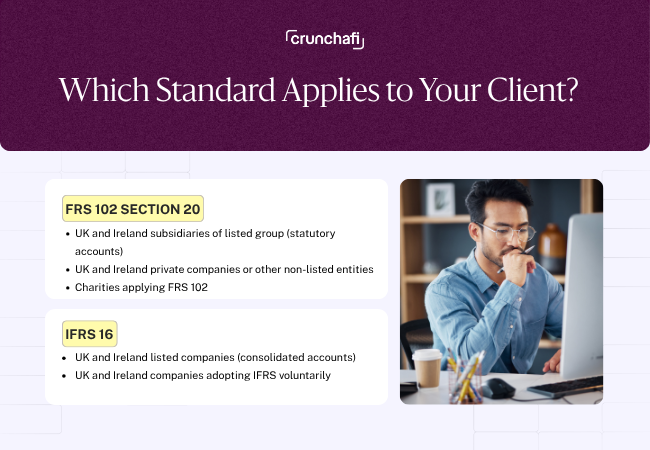
The two standards serve distinct reporting populations, though there is more overlap than it might first appear.
In short: if your client prepares statutory accounts under UK and Ireland GAAP, FRS 102 Section 20 applies.
Under both the revised FRS 102 Section 20 and IFRS 16, lessees are required to recognise a right-of-use asset and a corresponding lease liability at the commencement date for all leases within scope (subject to the short-term and low-value exemptions). The measurement approach is broadly consistent. However, there is one important difference: FRS 102 Section 20 introduces a practical simplification on the discount rate that IFRS 16 does not offer.
Where a lessee elects the short-term or low-value exemption under FRS 102, those leases are expensed on a straight-line basis and remain off-balance sheet, consistent with the equivalent exemptions under IFRS 16. Outside those exemptions, all leases require on-balance-sheet recognition under both standards.
For firms whose clients have significant lease portfolios, the practical question is not which leases go on-balance sheet, but how the discount rate, low-value threshold, and modification rules differ between the two standards.
Both standards require the lease liability to be measured using the interest rate implicit in the lease. Where that rate cannot be readily determined, the two standards diverge.
The obtainable borrowing rate is specifically defined as the rate the lessee would pay to borrow, over a similar term, an amount equal to the total undiscounted lease payments. The incremental borrowing rate is based on borrowing to obtain an asset of similar value to the right-of-use asset. In practice, the obtainable borrowing rate is often simpler to determine, making it a genuinely useful option particularly for smaller entities without a ready incremental borrowing rate.
There is also a difference in how the two standards treat modifications and discount rates.
This practical concession can reduce complexity for clients with frequently amended lease portfolios.
Both standards permit lessees to elect not to recognise right-of-use assets and lease liabilities for short-term leases of 12 months or less, and leases of low-value assets. The mechanics are similar, but the low-value threshold is handled differently.
What FRS 102 deliberately avoids is telling you what can be considered low value, and that's the point. The standard is designed to give preparers room to make that call. The Basis for Conclusions confirms that the kinds of assets IFRS 16 calls out as low value would be acceptable under FRS 102 too, but that's offered as helpful context, not a defined ceiling.
The FRC's intent is clear: this flexibility should mean fewer leases ending up on the balance sheet under FRS 102 than under IFRS 16. For firms advising asset-light businesses with numerous small leases, this distinction is worth factoring into the transition assessment.
Both standards require substantive lease disclosures, and the broad structure is similar. That said, there are two notable areas where FRS 102 Section 20 requires more than IFRS 16, and one area where it requires less.
The two standards have different effective dates and different transition approaches, both worth understanding clearly if your firm manages clients across UK and Ireland GAAP and IFRS.
Implications for Your Firm
For chartered accountancy firms managing clients under both standards, the technical differences above translate into real workflow decisions. Here's where they surface most directly.
Journal Entries and Workpapers
The journal entries will feel familiar to anyone used to IFRS 16, with right-of-use asset and lease liability on day one, then interest and depreciation over the lease term. Leases qualifying for the short-term or low-value exemption are still expensed straight-line with likely no balance sheet impact, assuming no variability in payments over the lease term. The points to watch are the discount rate options and modification rules, where FRS 102 and IFRS 16 diverge and your templates need to reflect FRS 102 specifically rather than defaulting to IFRS 16.
Audit Support
The ROU asset roll forward under FRS 102 is more detailed than its IFRS 16 equivalent, so audit files for UK and Ireland GAAP clients need to include the full reconciliation by class of underlying asset unless the client qualifies as a small entity. Build this into your templates now rather than finding the gap mid-fieldwork.
Know Your Defaults
Both standards now put leases on the balance sheet the same way, so the big conceptual hurdle is gone. The differences that remain (discount rates, low-value thresholds, modification rules, disclosure formats) mean an IFRS 16 workflow won't translate cleanly to FRS 102. If your team's assumptions have been shaped by years of IFRS 16 work, pressure-test those against FRS 102 Section 20 before they slip unchecked into your UK and Ireland GAAP workflow.
Group Reporting
Where a client is a UK or Ireland subsidiary of an IFRS-reporting parent, the group consolidated accounts will apply IFRS 16 while the subsidiary's individual statutory accounts are prepared under FRS 102 Section 20. This is a common and legitimate approach under UK or Ireland company law, as subsidiaries are not required to mirror the group's reporting framework in their own statutory filing. Both sets of accounts need to be prepared correctly for the standard they fall under, which means the same underlying leases may be accounted for differently depending on which set of accounts you are working on.
The Bottom Line
The two standards now share the same on-balance-sheet model for lessees, but they were built for different reporting populations and diverge in their discount rate options, low-value asset thresholds, modification rules, and disclosure formats. With the January 2026 effective date now passed, this is the right moment to audit your existing workflows and templates against FRS 102 Section 20 specifically, not IFRS 16 by default.
A Note on Tooling
Managing lease portfolios across both standards? The discount rate options, disclosure formats, low-value thresholds, and transition rules differ enough that a single workflow creates gaps. Crunchafi’s Lease Accounting software is built to handle both FRS 102 Section 20 and IFRS 16, so each client’s accounts are prepared against the standard that actually governs them.
For a deeper look at FRS 102 Section 20 in practice, see our complete guide to FRS 102 Section 20 lease accounting for chartered accountancy firms and our examples of lease accounting journal entries under FRS 102 Section 20.
FAQs
Is FRS 102 the same as IFRS?
No. FRS 102 is the UK and Ireland’s primary accounting standard for entities that do not apply IFRS. It was developed with IFRS compatibility in mind, and the revised Section 20 draws heavily on IFRS 16, but the two are separate frameworks with distinct requirements, disclosure obligations, and scope rules.
How does FRS 102 lease accounting differ from IFRS 16?
Both standards now require lessees to recognise a right-of-use asset and lease liability for most leases. The revised FRS 102 Section 20 removed the finance/operating lease distinction for lessees with effect from 1 January 2026. The key remaining differences are: FRS 102 offers an additional discount rate option (the obtainable borrowing rate); FRS 102’s low-value asset approach is more permissive and intentionally set at a higher threshold than IFRS 16; FRS 102 allows the original discount rate to be retained in three specific modification scenarios where IFRS 16 does not; FRS 102 requires a more detailed ROU asset roll forward in disclosures; and on transition, FRS 102 requires a modified retrospective approach only, whereas IFRS 16 also offered a full retrospective option. Small entities under FRS 102 also benefit from reduced disclosure requirements not available under IFRS 16.
Can a firm apply IFRS 16 instead of FRS 102 Section 20?
An entity in the UK entity or Ireland preparing statutory accounts under FRS 102 cannot substitute IFRS 16. FRS 102 Section 20 governs lease accounting for UK and Ireland GAAP preparers. However, an entity may choose to adopt IFRS in full (in which case IFRS 16 would apply), but this is a significant reporting decision with broad implications beyond lease accounting alone.