
The article is divided into key sections to help break down the calculations.
Date & Month
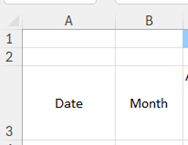
The first two columns will show the period for which the lease activity is recorded by Date in (YYYY-MM) format, and the �Month� count.
Revenue
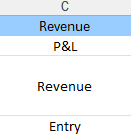
P&L Amortized Revenue (Column C):
Revenue is recognized on a straight-line basis per day over the lease term. For leases that begin or end mid-month (e.g., February), the system calculates revenue based on the exact number of active days in that month, ensuring accuracy in monthly recognition.
Example for partial months:
First Month: 1/20�1/31 = 22 days.
Last Month: 12/1�12/31 = 30 days.
Days in full months between = 660 days.
Total Days = 712.
Deferred Rent

LT Deferred Rent (Column D):
Shows the difference between the cash receipt and the monthly revenue amount.
LT & ST Deferred Rent EOM (Column E):
Combined total of Short-Term and Long-Term Deferred Rent.
LT Deferred Rent (Column F):
Provides Deferred Rent to be collected beyond 12 months.
ST Deferred Rent (Column G):
Provides Deferred Rent to be collected within 12 months.
LT Deferred Rent EOM (Column H):
Shows total Long-Term Deferred Rent at the end of the current month.
ST Deferred Rent EOM (Column I):
Shows total Short-Term Deferred Rent at the end of the current month.
Initial Direct Costs
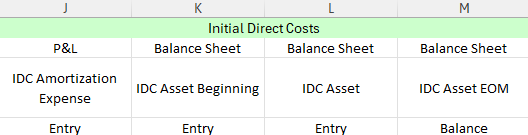
IDC Amortization Expense (Column J):
Any Initial Direct Costs incurred to execute the lease (e.g., legal fees or commissions) will be capitalized and amortized over the lease term on a straight-line basis.
IDC Asset Beginning Expense (Column K):
The opening balance of the Initial Direct Cost Asset for the period.
IDC Asset (Column L):
Adjustments to the Initial Direct Cost Asset during the period.
IDC Asset EOM (Column M):
The closing balance of the Initial Direct Cost Asset at the end of the month.
Cash/Clearing Account & Other Entries

Cash/Clearing Lease Receipt (Column N):
Actual cash inflow from lease receivables during the period.
Cash/Clearing IDC Payment (Column O):
Cash paid for Initial Direct Costs.
Cash/Clearing Variable Lease Receipt (Column P):
Cash inflow from Variable Lease Receivables.
Cash/Clearing Non-Lease Receipt (Column Q):
Other Cash Receipts not related to fixed Lease Receivables.
Summary of All Cash/Clearing Entries (Column R):
Net cash movement in the clearing account for the period.
Variable Lease Revenue (Column S):
Revenue recognized from Variable Lease Receivables.
Other P&L Accounts (Column T) & Other BS Accounts (Column U):
Other income and balance sheet entries not categorized elsewhere.