
The article is divided into key sections to help break down the calculations.
Date & Month
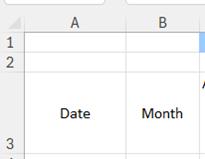
The first two columns will show the period for which the lease activity is recorded by Date in (YYYY-MM) format, and the �Month� count.
Amortization/Operating Lease Expense & ROU Asset
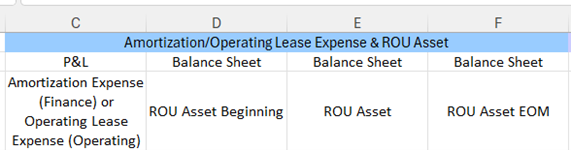
P&L Amortization Expense -Finance/ Operating Lease Expense- Operating (Column C):
Under ASC 842, operating lease expenses are recognized on a straight-line basis, while finance leases amortize the ROU Asset.
- Operating Lease: Calculated by dividing the Total Lease Payments by the lease term.
- Finance Lease: Determined as the ROU Asset Beginning Balance divided by the ROU Asset Life.
In the final month, the remaining amount ensures the ROU Asset value is reduced to $0.
ROU Asset Beginning (Column D):
Includes:
- Initial measurement of the Lease Liability (PV of future payments)
- Base lease payments made on or before the 15th of the lease start month
- Any Initial Direct Costs (if any)
- Subtracted: Incentives Received (if any)
ROU Asset (Column E):
The reduction in the ROU asset.
- Operating: Operating Lease Expense principal portion
- Finance: Amortization Expense principal portion
ROU Asset EOM (Column F):
Total of the ROU Asset at the end of the month, incorporating Amortization.
Interest Expense & Lease Liability

LT Liability Beginning (Column G):
- Present Value (PV) of lease payments: payments are discounted back to the start date. For more information, visit Present Value Calculations in LeaseCrunch.
- Payments from the 1st�15th of the month are excluded from PV calculations for base leases but included in ROU Asset. For more information, visit Why is the first payment missing from the Lease Liability?
- Transition leases include all payments in liability calculations but exclude pre-start date payments. For more information, visit What is a Transition Lease?
Interest Expense (Column H - Finance Leases):
- Monthly interest is calculated as: Previous EOM Liability Balance (Column l) - (Payments BOM (Column J) + EOM (Column K) included in LT Liability) x (Discount rate/12) .
LT Liability (Interest) (Column I):
Monthly accrual of total lease payment's interest portion.
LT Liability (Payment at BOM) (Column J):
Monthly payments processed at the beginning of the month (1st - 15th) that were included in the calculation of the lease liability.
LT Liability (Payment at EOM) (Column K):
Monthly payments processed at the end of the month (16th - EoM) that were included in the calculation of the lease liability.
Total ST & LT Liability (Column L):
The total remaining Lease Liability at the end of the month.
Long-Term Liabilities (Column M):
The portion of Long-Term Liability maturing within the next 12 months, per the standard that will be reclassified as current liability.
Short-Term Liabilities (Column N)
Current liability maturing within the next 12 months.
- Total amount of lease principal payments (Column J & K) plus Interest Expense (Column I) due within the next 12 months.
Long-Term Liabilities EOM (Column O):
Accumulated total of LT Lease Liability minus the reclassified ST Lease Liability as of the EOM.
Short-Term Liabilities EOM (Column P)
Accumulated total of ST Lease Liability as of the EOM.
Cash/AP & Other Entries

Cash/AP for Lease Payment at BOM (Column Q)
- Payment made between the 1st � 15th of the month.
Cash/AP for Lease Payments at EOM (Column R)
- Payments made between 16th � end of the month.
Cash/AP for Variable Lease Expense Payment (Column S) & Cash/AP for Non-Lease Payment (Column T):
- Payments made in the month recorded as a Variable and Non-lease expense.
Cash/AP (Summary of all Cash/AP Entries) (Column U):
- Reflects the sum of all cash payments for the month.
Variable and Non-Lease Payments (Column V to X):
Specific entries made for variable expenses and non-lease costs are reflected in dedicated GL accounts.