
Client Advisory Services (CAS) is one of the fastest-growing service lines in public accounting. 63% of U.S. firms consider CAS as a key service, and 94% now offer advisory or consulting services.
But growth comes with growing pains. Only 51% of CAS firms are committed to continuous technology investment. The firms that don’t invest rely on manual client assessments for CAS, endless spreadsheets, and disconnected systems that prevent scalability and eat into margins.
On the flip side, the firms that do invest in CAS technology see higher total CAS revenue, average client revenue, and can serve a median of 100 clients (compared to 67).
The bottom line: no matter how talented your advisors, technology inefficiencies will limit how far a firm can grow.
The solution? Automation. By embracing CAS technology and data automation, CAS teams can standardize workflows, analyze client performance in real time, and scale their advisory reach.
Sometimes called CAAS (Client Accounting and Advisory Services), CAS is a service model that blends traditional accounting with forward-looking financial insights to help clients plan ahead and make strategic decisions.
The rise of Client Advisory Services technology has shifted how CPA firms deliver value. CAS services started with CAS 1.0. These services included bookkeeping, payroll, and compliance.
This has now evolved into CAS 2.0, where firms act more as strategic partners, providing real-time insights, financial forecasts, and KPI tracking that drive business growth.
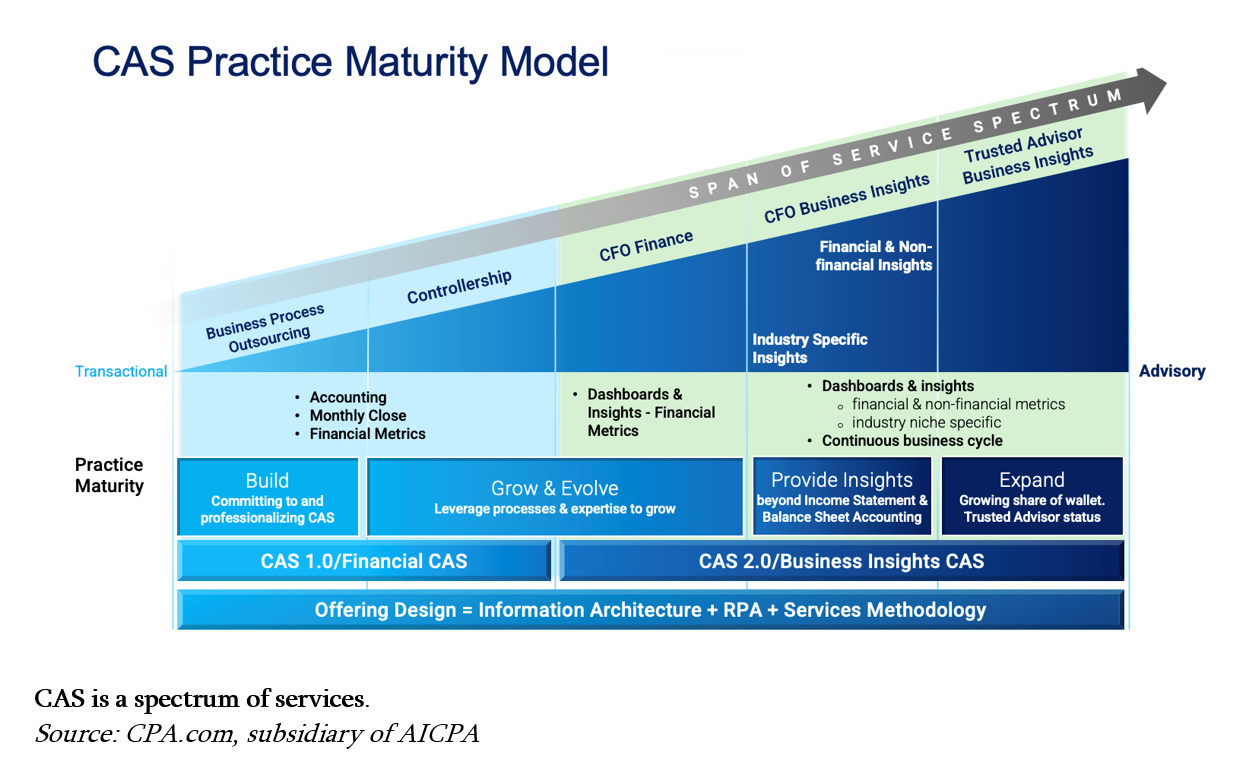
CPA firms have evolved their offerings due to growing client demand for advisory services. Business owners aren’t just looking for accountants to close the books. They want advisors who can interpret data, uncover trends, and guide their strategic decisions. As CAS-related revenue is projected to double over the next three years, the growing need for CAS technology is clear.
Yet, many firms are still weighed down by outdated processes. Manual client assessments in CAS drain hours. Spreadsheet-heavy workflows slow analysis. Disconnected systems create bottlenecks, and inconsistent data formats lead to messy, unreliable reports.
To unlock CAS growth, firms need a way to simplify the data layer. That’s where automation and CAS technology enter the picture.
For many firms, the start of a typical CAS engagement included an initial client assessment to scope the work and build the proposal. It often looked something like this:
It is a process that works until firms attempt to scale it. Because pricing and proposals are critical to getting an engagement started on the right footing, this work often falls to a partner or CAS leader.
In other words, the individual with the highest cost rate and the least available time is responsible for manually assembling fragmented data, building analyses from scratch, and shaping the final proposal. That approach quickly becomes a bottleneck as CAS practices grow.
More importantly, any gaps or missteps at this stage tend to carry forward. Missed issues can lead to under-scoped engagements, pricing that fails to reflect the true complexity of the client, or overlooked opportunities to deliver higher-value advisory services.
Once the engagement is underway, these mistakes are far harder to correct, often resulting in margin pressure, scope creep, or difficult conversations with the client later on.
That’s why automation is the key. It streamlines CAS tasks into repeatable processes that scale effortlessly, unlocking profitability, insight, and firm growth.
The most impactful result of integrating CAS technology into client advisory workflows is its effect on the client lifecycle. Here’s how it works:
Instead of sending endless data requests, CAS technology allows advisors to connect directly to a client’s accounting system or ERP for instant visibility into financials. No more waiting weeks for files. Instead, insights are available in minutes.
Once connected, data is automatically normalized, cleaned, and visualized. Advisors can quickly assess transaction volume, profitability, and trends without wrangling spreadsheets.
Finally, standardized, branded outputs make it simple to share findings. Not only is this invaluable during the client assessment/proposal process, but it gives you a clear starting point to provide KPI dashboards or monthly reports to compare to in a format that looks sharp, consistent, and client-ready every time.
When it comes to scaling a CAS practice, data is essential, but it also causes friction. CAS technology, like automated data extraction, removes that friction, turning manual work into a streamlined process. Here’s how automation reshapes CAS from the ground up.
Automation replaces the tedious back-and-forth of client data collection with one-click connections to accounting systems and ERPs. What once took hours of chasing spreadsheets and compiling reports now takes minutes.
Firms like Cherry Bekaert report reducing their deep insight turnaround time to just 24 hours, giving teams back valuable hours every week. Those reclaimed hours translate directly into more client capacity and less burnout.
By eliminating repetitive administrative work, automation frees CAS professionals to focus on activities that add the most value, including analyzing insights, advising clients, and building stronger relationships.
With access to real-time, structured financial data before an engagement begins, firms can accurately scope projects and quote with confidence.
Advisors can see a client’s transaction volume, complexity, and cleanup needs up front. This transparency helps firms prevent underpricing and eliminate scope creep, two of the biggest profit killers in CAS.
When proposals are backed by factual, client-specific data, clients see the value immediately. It builds trust and positions the firm as a data-driven partner, not just another compliance provider.
Manual data entry is an open invitation for errors. CAS technology solves that by pulling read-only data directly from the source.
Every engagement follows the same structure, producing standardized Excel workbooks and reports that make review and training simple.
Automation provides a 360° view of a client’s financial landscape, showing chart of accounts, AR/AP agings, vendor details, cash flow trends, and more in real time.
Plus, built-in analytics automatically generate profitability, liquidity, and cash flow ratios, complete with trend visualizations. CAS advisors gain instant, data-backed insights that fuel proactive decision-making.
With all the numbers in one place, advisors can easily identify red flags, seasonality patterns, and opportunities for optimization.
First impressions matter, and automation makes onboarding frictionless. Even non-technical clients can securely connect their data in minutes.
From there, advisors can deliver clear, visual reports that communicate complex financials in an approachable way. Branded dashboards and visuals elevate client confidence and reinforce the firm’s professionalism.
Most importantly, advisors can prove value early and often by showing measurable progress through each client’s own data.
CAS technology transforms one-off projects into repeatable, standardized workflows that scale easily across teams, offices, and client types.
Firms can onboard new clients faster, deliver consistent outputs, and expand capacity without adding headcount. This leads to sustainable growth without overworked staff or inflated costs.
Automation continues to add value throughout an engagement. Monthly KPI dashboards and trend reports update automatically, allowing advisors to track client health, identify risks early, and suggest improvements proactively.
In a market flooded with lookalike firms, CAS technology sets leaders apart. Automated data extraction modernizes a firm’s reputation and shows clients that you’re innovative, efficient, and future-focused.
By leveraging automation, smaller firms can compete head-to-head with larger players, offering faster turnaround and richer insights without ballooning overhead. It also opens doors to new revenue streams like KPI reporting, forecasting, and data visualization services.
As CAS continues to redefine the accounting landscape, the firms that win will be those that embrace CAS technology from end to end.
Crunchafi’s Data Extraction software connects seamlessly to your clients' numbers, giving firms instant access to clean, reliable data that flows directly into calculations, forecasts, and advisory dashboards. The result is a unified, insight-driven workflow that eliminates inefficiency and amplifies advisory value.
Built by CPAs, for CPAs, Crunchafi equips CPA firms to save time, simplify processes, and strengthen client relationships. Our software is designed to grow with your firm, not slow it down.
If you’re interested in adopting automation, scaling your CAS services, and delivering measurable results that make your firm a leader in the future of advisory growth, schedule a demo to learn more about how our software suite can help.